
Let me ask you something. Have you ever checked your BMI online, seen the result say “Normal,” and felt relieved?
If yes, you may want to read this carefully. Because for most Indians, that “Normal” result on a standard BMI chart is actually not normal at all.
I am not saying this to scare you. I am saying this because there is a very real difference between the BMI scale originally developed for Western populations and the one that health experts now recommend for Indians specifically. The good news is that awareness about this difference is growing, and knowing the right numbers means you can make much better decisions about your health.
In this post, I will explain what BMI actually is, what the correct healthy range is for Indians specifically, how to calculate yours in two minutes, and most importantly, what to do with that number once you have it.
No complicated medical terms. No jargon. Just plain and simple.
What Exactly Is BMI?
BMI stands for Body Mass Index. It is simply a number calculated from your height and weight that gives doctors and health experts a quick idea of whether your weight is in a healthy range for your height.
Think of it like this: two people can weigh exactly 80 kilograms. But if one is 5 feet 4 inches tall and the other is 6 feet 2 inches tall, their weight means something very different in terms of health. BMI accounts for that height difference and gives you a single comparable number.
It is not a perfect measurement (we will talk about its limitations later), but it is a very useful starting point for understanding your weight and health.
How Is BMI Calculated?
The formula is straightforward:
BMI = Weight (in kg) ÷ Height² (in metres)So if you weigh 70 kg and your height is 1.65 metres (5 feet 5 inches):
BMI = 70 ÷ (1.65 × 1.65) = 70 ÷ 2.72 = 25.7
That is it. Nothing more complicated than that.
The BMI Chart Most Indians Are Using Is Wrong
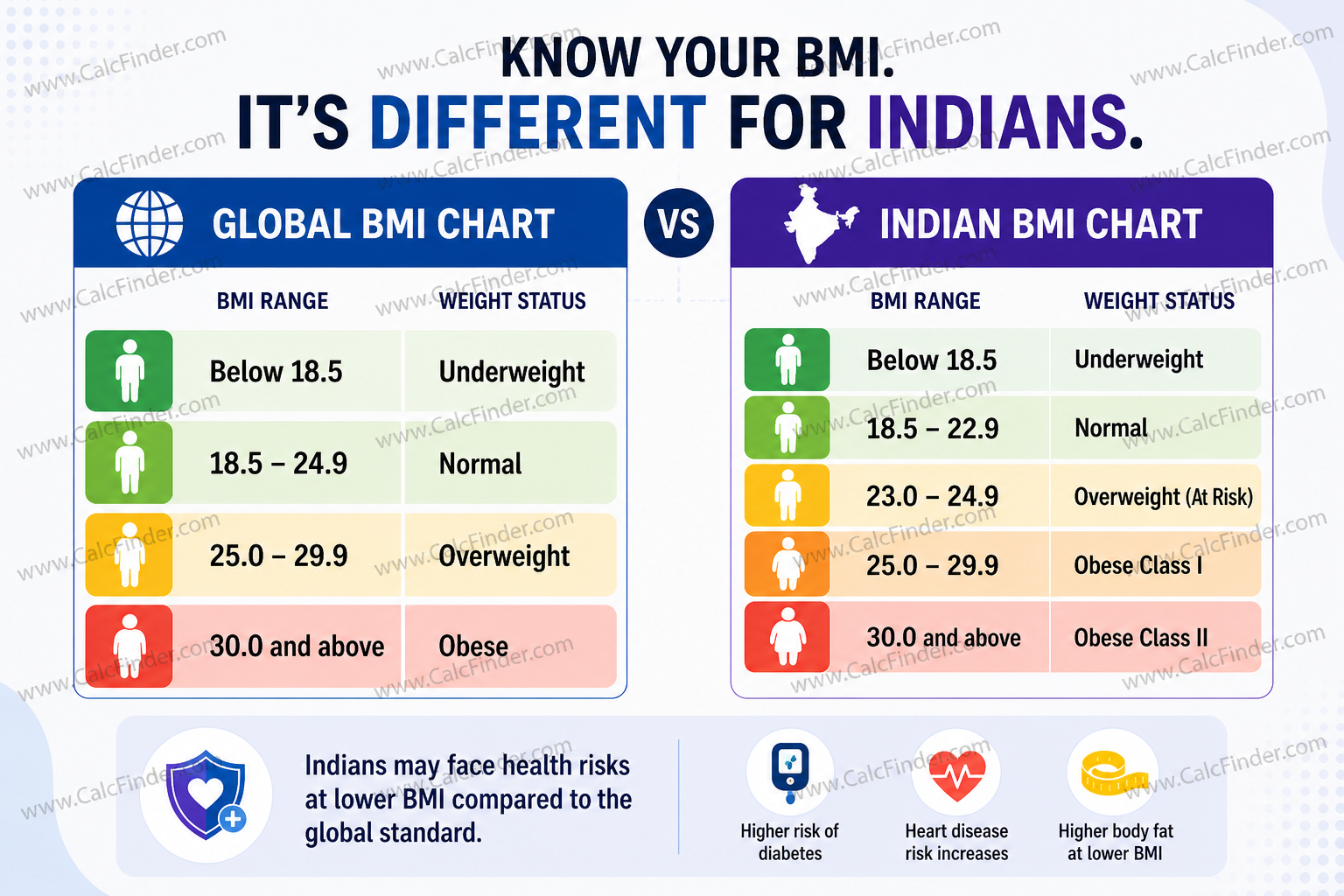
Here is something most people do not know. The standard BMI chart, the one that says “Normal = 18.5 to 24.9”, was originally created using data from European and Western populations. It was not designed with Indian or South Asian bodies in mind.
And this is a serious problem.
Research shows that Indians tend to carry significantly more body fat – especially around the stomach area – at the same BMI as someone from a Western country. This means an Indian person with a BMI of 24 may already have the same health risks as a European person with a BMI of 28 or higher.
The World Health Organisation (WHO) officially recognised this difference and recommended a separate, lower set of BMI cutoffs specifically for Asian and South Asian populations, which includes India.
The result: According to a large-scale study by ICMR, roughly 43% of Indians who fall in the “Normal” range on the standard global BMI chart are actually metabolically at risk; they just do not know it because they are using the wrong chart.
That is nearly half of all Indians with “normal” BMI carrying hidden health risks. That is a big deal.
The Correct BMI Range for Indians
Here is the BMI chart you should actually be using if you are Indian:
| BMI Range | What It Means for Indians |
|---|---|
| Below 18.5 | Underweight |
| 18.5 – 22.9 | ✅ Normal / Healthy |
| 23.0 – 27.4 | ⚠️ Overweight |
| 27.5 and above | 🔴 Obese |
Notice the key difference on the Indian scale, overweight starts at 23, not 25, like on the global WHO chart. And obesity starts at 27.5, not 30.
This lower threshold exists because our bodies naturally store more fat around the abdomen and internal organs at lower weights compared to people from Western countries. This type of fat, called visceral fat, is the more dangerous kind that increases your risk of diabetes, heart disease, and blood pressure problems.
How to Calculate Your BMI in 2 Minutes
You have two options: manual calculation or our free calculator (much faster).
BMI Calculation With an Example (in kg and cm)
Let us take a real example. Raj is a 35-year-old man from Mumbai. He weighs 78 kg and is 170 cm tall (5 feet 7 inches).
Step 1: Convert height to metres: 170 cm ÷ 100 = 1.70 metres
Step 2: Square the height: 1.70 × 1.70 = 2.89
Step 3: Divide weight by that number: 78 ÷ 2.89 = 27.0
On the global chart, Raj’s BMI of 27 would show as “Overweight.” But on the Indian chart, a BMI of 27 is approaching the obese range. This is exactly why using the right chart matters.
Use Our Free BMI Calculator – Instant Results
Rather than doing this math every time, use our free BMI Calculator above. Just enter your weight and height, and it gives you your result instantly using the correct Indian BMI thresholds, not the global ones. No login, no signup, completely free.
What Your BMI Number Actually Means for You
Getting your number is one thing. Understanding what to do with it is another. Here is what each range means in real, practical terms:
Underweight (Below 18.5)
If your BMI is below 18.5, your body may not be getting enough nutrition to function well. This is actually more common in India than people realise, especially among young women and people with physically demanding jobs who are not eating enough protein and calories.
Being underweight can lead to weak immunity, tiredness, hair loss, and nutritional deficiencies. If this is you, focus on increasing your calorie intake through foods like dal, rice, ghee, bananas, nuts, and paneer, not junk food.
Normal Weight (18.5 to 22.9)
This is the sweet spot for Indians. A BMI in this range means your weight is well-matched to your height and your risk of weight-related health problems is low.
However, and this is important, being in the normal range does not automatically mean you are healthy. Your diet quality, physical activity, sleep, and stress levels all matter too. Think of BMI as one data point, not the whole picture.
Overweight (23 to 27.4)
This is the range where most urban Indians quietly sit without realising it. At this level, the risk of Type 2 diabetes, high blood pressure, and cholesterol problems begins to creep up, especially if the weight is concentrated around your stomach.
The good news: this range is very manageable. A small, consistent change like a 30-minute walk five days a week and cutting down on maida and sugary drinks can move you back into the normal range within a few months.
Obese (27.5 and Above)
A BMI above 27.5 is classified as obese by Indian health standards. At this level, the risk of serious health conditions, including heart disease, diabetes, fatty liver, and joint problems, is significantly elevated.
This does not mean a diagnosis of anything. It simply means your body is carrying more weight than it can comfortably manage, and it is worth taking action, ideally with guidance from a doctor or qualified nutritionist.
Why Belly Fat Matters More Than the Number on Your Scale
Here is something I want every Indian reader to know, because very few people talk about it clearly.
Your weighing scale and even your BMI cannot tell you where your fat is stored. And for Indians, this is crucial.
Indians genetically tend to store more fat around the abdomen, stomach, liver, and other internal organs. This is called visceral fat, and it is far more dangerous to health than fat stored under the skin on your arms, thighs, or back.
Two people can have the exact same BMI of 24. One person carries their fat on their hips and thighs — lower risk. The other carries it around their belly much higher risk for diabetes and heart disease.
This is why health experts also recommend measuring your waist circumference alongside your BMI. For Indians, the risk thresholds are:
| High Risk Waist Size | |
|---|---|
| Men | More than 90 cm (about 35.5 inches) |
| Women | More than 80 cm (about 31.5 inches) |
If your waist is above these numbers, even if your BMI looks okay, it is worth paying attention to your diet and activity levels.
5 Things BMI Cannot Tell You
BMI is useful, but it is not the full story. Here are five things it genuinely cannot measure:
1. Muscle vs fat: A regular gym-goer or sportsperson may have a high BMI simply because muscle weighs more than fat. Their actual health risk is low. BMI treats muscle and fat the same, which is a real limitation.
2. Where your fat is stored: As we just discussed, belly fat is more dangerous than fat elsewhere. BMI cannot distinguish between the two.
3. Your bone density: People with denser, heavier bones may score higher on BMI without carrying excess fat.
4. Your age: As we get older, our body composition changes; we typically lose muscle and gain fat even at the same weight. BMI does not adjust for this.
5. Your actual fitness level: A person who walks 10,000 steps a day, eats well, and sleeps properly but has a BMI of 24 is in much better health than a sedentary person with a BMI of 21. BMI cannot capture fitness.
Use BMI as a starting point, not as a final verdict on your health.
Frequently Asked Questions About BMI for Indians
Is a BMI of 23 bad for Indians?
A BMI of 23 falls at the very start of the overweight range on the Indian BMI chart. It is not alarming, but it is a signal to be mindful. At this level, the focus should be on maintaining a healthy diet, staying active, and keeping an eye on your waist measurement. It does not mean you are unhealthy, just that there is a small margin worth attention.
What is the ideal BMI for Indian women?
The ideal BMI range for Indian women is the same as for Indian men — between 18.5 and 22.9. While some older global guidelines suggested slightly different ranges for women, Indian health authorities, including ICMR, recommend the same healthy range for both genders using Indian-specific thresholds.
Can a person have a normal BMI but still be unhealthy?
Yes, and in India, this is surprisingly common. A landmark study by ICMR found that around 43% of Indians who appear “normal” by global BMI standards are actually metabolically at risk due to high visceral fat, a condition called Metabolically Obese Normal Weight (MONO). This is why doctors in India also check waist circumference, blood sugar, and cholesterol alongside BMI.
The Bottom Line – What Should You Do Next?
Your BMI is one of the easiest health numbers you can calculate – and if you are using Indian standards, it is genuinely useful. Here is a quick summary of what to take away:
- The healthy BMI range for Indians is 18.5 to 22.9 – lower than the global standard
- Overweight for Indians starts at BMI 23, not 25
- BMI alone is not enough – also check your waist measurement
- A high BMI is a signal, not a sentence – small consistent changes make a real difference
- If your BMI is above 27.5, speaking to a doctor is genuinely worth it
The best first step? Calculate your number right now – it takes 30 seconds and costs nothing.
Check your BMI right now: Use our free BMI Calculator for Indians – it uses the correct Indian BMI thresholds recommended by WHO, not the outdated global chart. Enter your weight and height and get your result, your healthy weight range, and what your number means for you – instantly.
DISCLAIMER: This article is for informational purposes only and is not a substitute for professional medical advice. Always consult a qualified healthcare provider for any health concerns.