
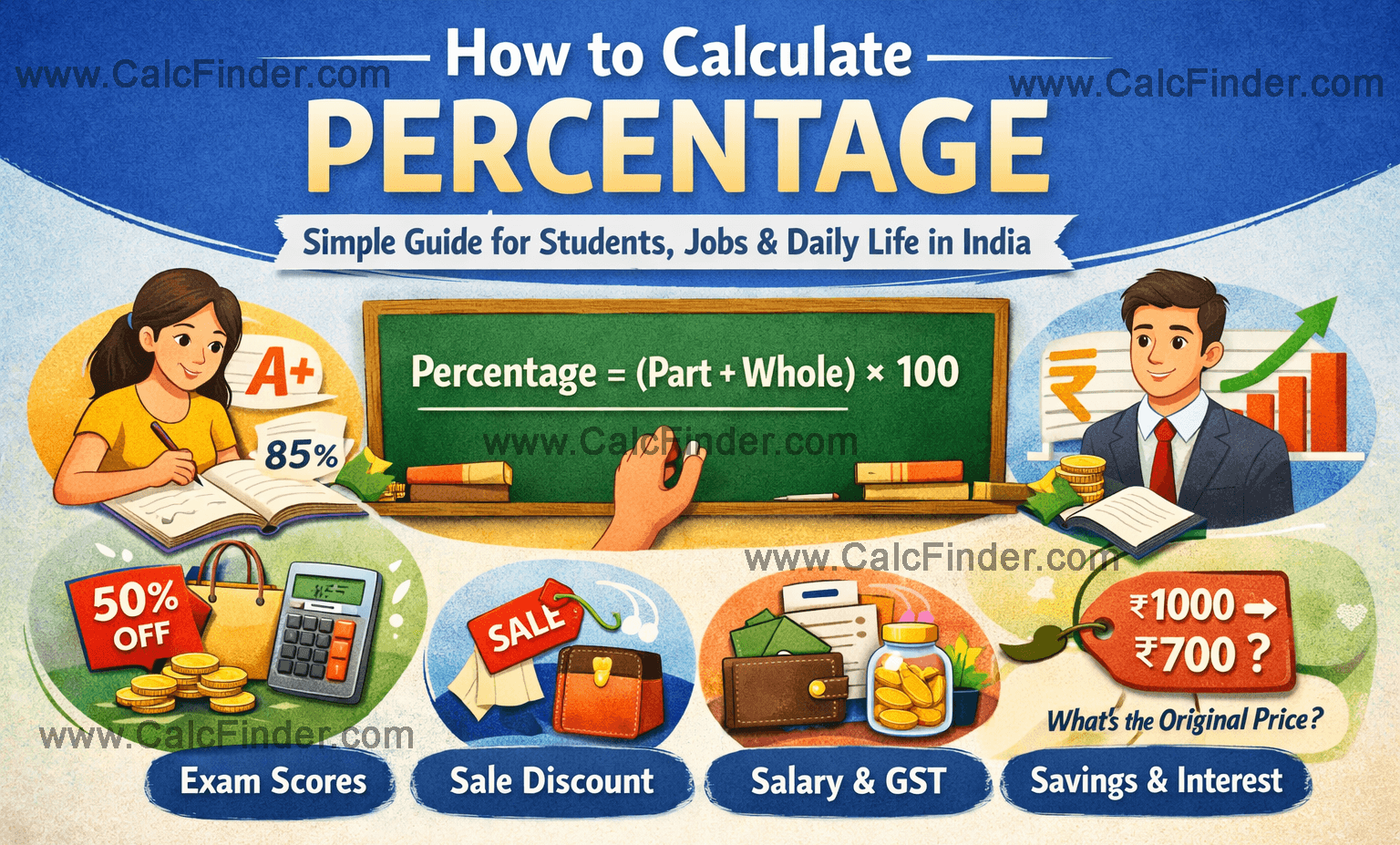
You are standing at a clothing store during a sale. The shirt you want has an MRP of Rs. 1,200, and the board says “40% off.” Quick – how much will you actually pay?
If that question made you pause even for a second, you are not alone. Percentages are everywhere in daily Indian life; in your exam results, your salary slip, your shopping bills, your bank statement, and your GST invoice. Yet most of us never got a clear, practical explanation of how they actually work.
In school, percentages were taught with abstract textbook problems nobody cared about. In this guide, I am going to explain everything with real situations, marks, discounts, salary hikes, and GST things that actually matter to you. No confusing math language. No unnecessary steps. Just simple, practical percentage calculations you can use starting today.
And if you ever just want a quick answer without doing any math at all, our free Percentage Calculator at the top of this page gives you an instant result in seconds.
What Is a Percentage? (In Plain English)
A percentage is simply a way of expressing a number as a part of 100.
The word “percent” comes from the Latin phrase “per centum,” which literally means “out of one hundred.”
So when someone says “you scored 85%,” they mean out of every 100 marks possible, you got 85. When a bank says “your savings account gives 6.5% interest per year,” they mean that for every Rs. 100 you keep in your account, you earn Rs. 6.50 per year.
That is all a percentage ever means. A number out of 100.
Once you understand that, everything else becomes simple.
The One Formula You Need to Remember
All percentage calculations, no matter how different they seem, come back to one basic formula:
Percentage = (Part ÷ Whole) × 100Write this down somewhere. Stick it on your wall if you have to. This single formula solves at least 80% of all percentage questions you will ever encounter in daily life.
Breaking It Down With a Simple Example
Suppose you scored 72 marks out of 90 in your Science test.
- Part = your marks = 72
- Whole = total marks = 90
Percentage = (72 ÷ 90) × 100 = 0.8 × 100 = 80%
You scored 80%. Simple.
The formula works for anything; marks, money, quantities, populations, anything at all. Just identify what the ” part is” and what is the “whole,” and the formula does the rest.
6 Real-Life Situations Where Indians Use Percentages Every Day
Let us go through the most common situations where you will actually need to calculate a percentage with a real Indian example for each one.
1. Calculating Your Exam Marks Percentage
This is probably the most common reason students in India search for percentage calculations, especially during the board exam results season.
Formula:
Percentage of marks = (Marks obtained ÷ Total marks) × 100Example: Riya scored the following in her Class 10 exams:
- Hindi: 88, English: 79, Maths: 92, Science: 85, Social Science: 81
- Total marks obtained: 88 + 79 + 92 + 85 + 81 = 425
- Total maximum marks: 500 (5 subjects × 100 each)
Riya’s percentage = (425 ÷ 500) × 100 = 85%
2. Finding the Discount Price During a Sale
Diwali sales, end-of-season sales, Big Billion Day, we all love a good discount. Here is how to know exactly what you are paying.
Formula:
Discount amount = (Discount % ÷ 100) × Original price
Final price = Original price - Discount amount
Example: That ₹1,200 shirt from the beginning of this post with 40% off:
Discount amount = (40 ÷ 100) × 1,200 = 0.40 × 1,200 = ₹480
Final price = ₹1,200 − ₹480 = ₹720
You save ₹480. Now you know before you reach the billing counter.
3. Understanding Your Salary Hike
Appraisal season is one of the most common times adults need to calculate percentages and get confused doing it.
Formula:
Hike percentage = ((New salary − Old salary) ÷ Old salary) × 100Example: Amit’s salary was ₹45,000 per month. After his appraisal, it became ₹51,300 per month.
Hike = ((51,300 − 45,000) ÷ 45,000) × 100
Hike = (6,300 ÷ 45,000) × 100
Hike = 0.14 × 100 = 14% salary hike
You can also use this formula in reverse if your HR says you are getting a 10% hike, you can calculate exactly what your new salary will be:
New salary = Old salary + (10% of old salary) New salary = ₹45,000 + ₹4,500 = ₹49,500
4. Calculating GST on a Bill
GST is everywhere in India now, from your restaurant bill to your mobile phone purchase. Knowing how to calculate it means you can verify your bill is correct.
Formula:
GST amount = (GST rate ÷ 100) × Base price
Total bill = Base price + GST amount
Example: You had dinner at a restaurant. The food total before tax was ₹1,800. GST rate is 5%.
GST amount = (5 ÷ 100) × 1,800 = ₹90
Total bill = ₹1,800 + ₹90 = ₹1,890
Our GST Calculator on CalcFinder.com does this instantly. If you want to skip the math, it even handles the CGST and SGST split automatically.
5. Checking How Much You Have Saved This Month
Trying to track your monthly savings? Here is how to express it as a percentage of your income, which is far more meaningful than just a rupee amount.
Formula:
Savings percentage = (Amount saved ÷ Monthly income) × 100Example: Priya earns ₹35,000 per month and saved ₹7,000 this month.
Savings rate = (7,000 ÷ 35,000) × 100 = 20%
Financial advisors generally recommend saving at least 20% of your income, so Priya is right on target. This is a quick way to check where you stand every month.
6. Understanding Bank Interest on Savings
When your bank says your savings account gives 4% per year, here is what that actually means in rupees.
Formula:
Interest earned = (Interest rate ÷ 100) × Amount in accountExample: You have ₹50,000 in a savings account at 4% per year.
Interest = (4 ÷ 100) × 50,000 = ₹2,000 per year
That is ₹2,000 earned simply for keeping money in your account. For larger amounts or fixed deposits, this adds up meaningfully, especially with compound interest, which we covered in our previous post.
How to Calculate Percentage of Marks (Step by Step)
Since this is one of the most searched topics in India, especially by students and parents, let us go through it properly for different exam types.
Single Subject Percentage
Percentage = (Marks obtained ÷ Maximum marks) × 100Example: You scored 67 out of 80 in your Hindi paper. Percentage = (67 ÷ 80) × 100 = 83.75%
Overall Percentage Across Multiple Subjects
Add up all your marks obtained, divide by the total maximum marks across all subjects, then multiply by 100.
Overall % = (Total marks obtained ÷ Total maximum marks) × 100Example:
Five subjects, you scored 78 + 85 + 91 + 74 + 88 = 416 out of 500.
Overall percentage = (416 ÷ 500) × 100 = 83.2%
CBSE Board Exam Percentage (Class 10 and Class 12)
For CBSE Class 10 and Class 12, the total is typically 500 marks (5 main subjects × 100 each). Some schools include internal assessment marks; always confirm with your school which subjects and marks are counted.
For Class 12 students applying for college admissions, many colleges calculate your “best of four” or “best of five” percentage. In that case, add only those specific subjects, not all six if you studied six.
Pro tip for CBSE students: Your percentage and your CGPA are two different things. To convert CGPA to a percentage, multiply your CGPA by 9.5. So a CGPA of 9.2 = 9.2 × 9.5 = 87.4%.
Reverse Percentage – Working Backwards From a Final Number
This is slightly trickier but extremely useful, and once you understand it, you will use it all the time.
Reverse percentage means finding the original number when you already know the final number after a percentage change.
Real Example – Finding the Original Price After a Discount
You saw a pair of shoes for ₹1,560 labelled “after 35% discount.” What was the original price?
Here is the logic: if 35% was taken off, you are paying 65% of the original price.
Original price = Final price ÷ (1 − discount%)
Original price = 1,560 ÷ 0.65 = ₹2,400
The original price was ₹2,400. The discount saved you ₹840.
This is also useful for working out pre-GST prices. If your bill shows ₹2,360 including 18% GST:
Original price = 2,360 ÷ 1.18 = ₹2,000The GST charged was ₹360.
4 Common Percentage Mistakes Almost Everyone Makes
Mistake 1: Confusing the percentage of a number with percentage points
If your interest rate goes from 4% to 6%, that is an increase of 2 percentage points, but it is a 50% increase in the rate itself. These are two completely different things. Banks and financial companies sometimes use this confusion to their advantage.
Mistake 2: Using the wrong base for percentage change
Percentage change is always calculated on the original (old) value – not the new one. Many people accidentally divide by the new number, which gives a wrong answer. Always use the starting number as your base.
Mistake 3: Adding percentages directly
If a price increases by 10% and then decreases by 10%, most people assume you end up where you started. You do not. A 10% increase followed by a 10% decrease gives you 99% of the original a small net loss. Percentages applied in sequence are multiplicative, not additive.
Mistake 4: Forgetting to multiply by 100
The most common calculation error – running the formula (Part ÷ Whole) and forgetting the final × 100 step. The result looks like a decimal (0.83) instead of a percentage (83%). Always check that your final answer is in the right form.
Frequently Asked Questions About Percentages
What is 1% of 1 lakh?
1% of ₹1,00,000 = (1 ÷ 100) × 1,00,000 = ₹1,000. A quick mental shortcut – 1% of any number is simply that number divided by 100. So 1% of ₹5 lakh = ₹5,000. 1% of ₹10 lakh = ₹10,000.
How do I calculate the percentage increase in salary?
Use this formula: ((New salary − Old salary) ÷ Old salary) × 100. For example, if your salary went from ₹30,000 to ₹33,600 – the increase is ₹3,600, divided by ₹30,000 = 0.12, multiplied by 100 = 12% hike. You can also use our free Percentage Calculator above and select the “Percentage Change” option for an instant result.
How to convert CGPA to a percentage?
For CBSE: Multiply your CGPA by 9.5. Example – CGPA of 8.6 = 8.6 × 9.5 = 81.7%. For other universities like Mumbai University or VTU, the conversion formula may be different – check your university’s official guidelines, as they each have their own multiplier.
Key Takeaways
Percentage calculations are not complicated once you have the right formula in front of you. Here is everything in one place:
- The core formula is always: Percentage = (Part ÷ Whole) × 100
- For exam marks: add all subject marks, divide by total maximum, multiply by 100
- For discounts: calculate the discount amount first, then subtract it from the original price
- For salary hike: divide the increase by your old salary, then multiply by 100
- For GST: multiply the base amount by the GST rate divided by 100
- For reverse percentage: divide the final amount by (1 − the percentage as a decimal)
- Always use the original value as your base for percentage change calculations
Once you practise these a few times, they become second nature. And for every other time, our free Percentage Calculator is right here.
Skip the math entirely: Use our free Percentage Calculator above; it handles all six types of percentage calculations in one place. Works on mobile, no login needed, instant results. Whether you are checking your exam percentage, verifying a discount, or calculating your salary hike, it takes five seconds.