
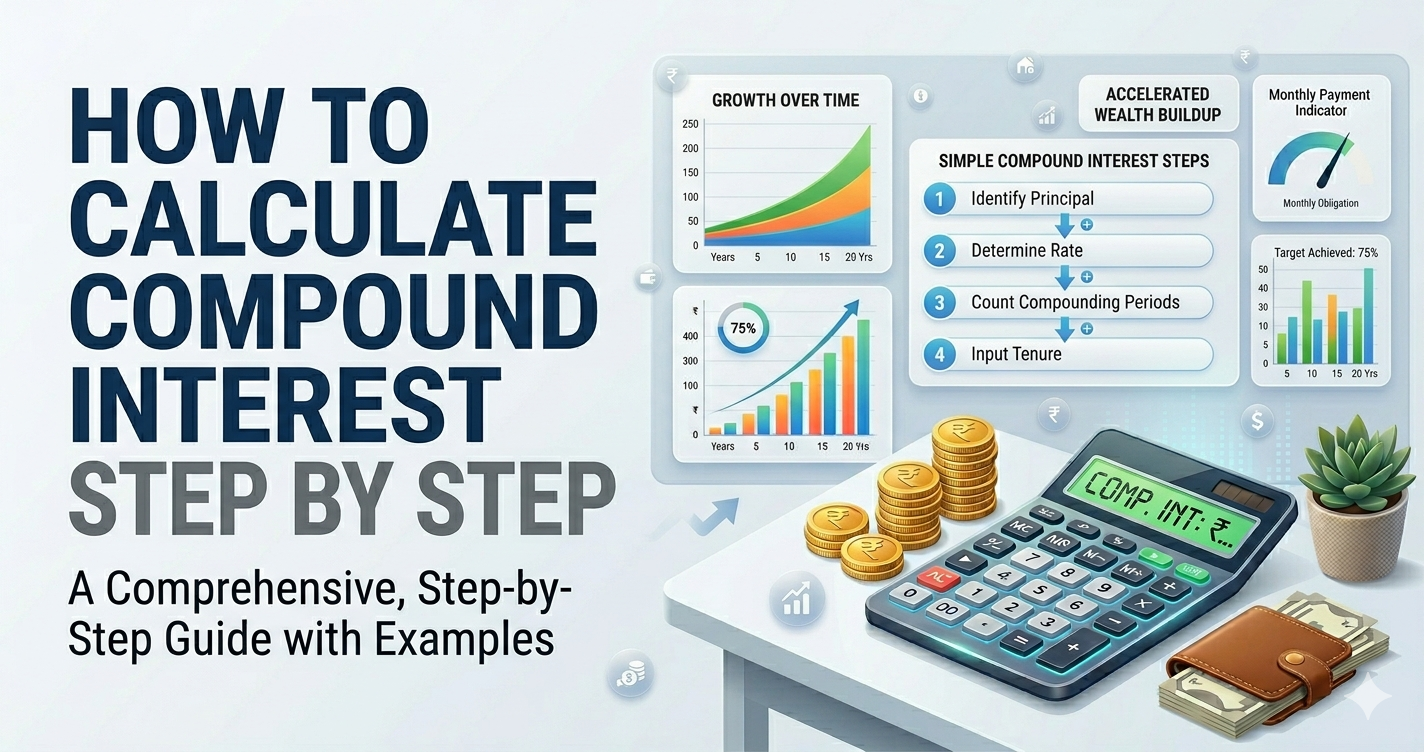
Most people know that keeping money in a savings account earns them “interest.” But here is the part that surprises almost everyone when they actually sit down and calculate it – the interest you earn in year two is not just on your original deposit. It is on your original deposit plus the interest you already earned in year one.
That single idea – interest earning interest – is the entire concept of compound interest. And once you truly understand how it works, you will look at every savings account, fixed deposit, mutual fund, and loan very differently. I have seen people shocked to discover their FD was worth far less than they assumed because they did not understand how frequently interest was being compounded.
In this guide, I will walk you through the compound interest formula step by step, show you a worked example in rupees, highlight the one mistake most people make, and show you how to calculate it in seconds using our free Compound Interest Calculator.
What Is Compound Interest?
Compound interest is interest calculated on both the principal amount (your original money) and the accumulated interest from previous periods. In simple terms, your interest starts earning interest of its own.
This is what separates a smart long-term investment from a mediocre one, and it is also why unpaid debt can grow faster than people expect.
Compound Interest vs Simple Interest – Key Difference
Simple interest only ever calculates on your original principal, no matter how long the money sits. Compound interest recalculates on a growing base:
- Simple interest on ₹1,00,000 at 8% for 5 years = ₹40,000 total interest
- Compound interest on ₹1,00,000 at 8% for 5 years (annually) = ₹46,933 total interest
That extra ₹6,933 is the power of compounding – and over longer periods or larger amounts, this difference becomes enormous.
The Compound Interest Formula Explained
The standard formula used worldwide is:
A = P × (1 + r/n)^(n×t)Where:
| Symbol | Meaning | Example Value |
|---|---|---|
| A | Final amount (principal + interest) | What you want to find |
| P | Principal (starting amount) | ₹1,00,000 |
| r | Annual interest rate (as a decimal) | 8% = 0.08 |
| n | Number of times interest compounds per year | 12 (monthly), 4 (quarterly), 1 (annually) |
| t | Time in years | 5 |
How to Find Just the Interest Earned
The formula above gives you the final amount (A) – your principal plus all interest. To find only the interest earned, simply subtract your original principal:
Compound Interest = A − P
So if your final amount is ₹1,46,933 and you started with ₹1,00,000, your compound interest earned is ₹46,933.
How to Calculate Compound Interest Step by Step (Worked Example)
Let us take a real Indian scenario. Suppose you invest ₹2,50,000 in a Fixed Deposit with SBI at an interest rate of 6.8% per annum, compounded quarterly, for 3 years.
Your values:
- P = ₹2,50,000
- r = 6.8% = 0.068
- n = 4 (quarterly compounding)
- t = 3 years
Step 1 – Divide the Rate by Compounding Frequency
r ÷ n = 0.068 ÷ 4 = 0.017
This gives you the interest rate applied each quarter.
Step 2 – Calculate (1 + r/n)
1 + 0.017 = 1.017
Step 3 – Calculate the Exponent (n × t)
n × t = 4 × 3 = 12
This is the total number of compounding periods over the full 3 years.
Step 4 – Raise to the Power
(1.017)^12 = 1.2213 (approximately)
Step 5 – Multiply by Principal to Get Final Amount
A = ₹2,50,000 × 1.2213 = ₹3,05,325
Total compound interest earned = ₹3,05,325 − ₹2,50,000 = ₹55,325
If this had been simple interest at the same rate, you would have earned only ₹51,000. The difference is ₹4,325 – and that gap grows dramatically with larger amounts or longer timeframes.
How Compounding Frequency Affects Your Returns
One thing most people completely overlook is how often the interest compounds. The more frequently it compounds, the more you earn – even at the same annual rate. This is one of the most important things to check before opening any FD or savings account.
Annual vs Quarterly vs Monthly Real Comparison
Here is what happens to ₹1,00,000 at 8% over 10 years with different compounding frequencies:
| Compounding | Final Amount | Interest Earned |
|---|---|---|
| Annually (1x/year) | ₹2,15,892 | ₹1,15,892 |
| Quarterly (4x/year) | ₹2,20,804 | ₹1,20,804 |
| Monthly (12x/year) | ₹2,21,964 | ₹1,21,964 |
| Daily (365x/year) | ₹2,22,534 | ₹1,22,534 |
Monthly compounding earns you ₹6,072 more than annual compounding – just by how the same bank calculates your interest. Always check your FD or savings account’s compounding frequency before comparing rates across banks.
The Most Common Mistake People Make With Compound Interest
The single biggest mistake I see is people confusing the interest rate with the effective annual rate (EAR) when compounding is more frequent than annually.
What Is the Effective Annual Rate (EAR)?
A savings account offering 8% per annum compounded monthly does not give you exactly 8% at the end of the year. It gives you slightly more – approximately 8.3%. This higher figure is called the Effective Annual Rate (EAR).
Many people compare a bank offering 8% compounded annually with another offering 7.8% compounded monthly – and automatically pick the 8% one. In reality, 7.8% compounded monthly gives you an EAR of about 8.08%, which is actually better than the 8% annual option.
The lesson: always calculate using the formula, or use a calculator that handles compounding frequency properly – rather than comparing headline rates at face value.
Frequently Asked Questions About Compound Interest
Does PPF Use Compound Interest?
Yes. PPF (Public Provident Fund) uses compound interest, calculated annually on the minimum balance between the 5th and last day of each month. For maximum benefit, deposit your yearly contribution before the 5th of April every year.
How Do I Calculate Compound Interest on a Home Loan?
Home loans in India use the reducing balance method – a form of compound interest where each EMI payment reduces the principal, which in turn reduces the base on which next month’s interest is calculated. Use our EMI Calculator to see the full year-by-year amortisation breakdown for your specific loan.
Is Compound Interest Always Better Than Simple Interest for Savings?
For savings – yes, always. Over any period longer than one year, compound interest will yield more than simple interest at the same rate. The longer the period, the larger the advantage. However, for borrowers, compound interest means your unpaid debt grows faster, which is why paying off high-interest debt quickly matters so much.
Key Takeaways – What to Remember
Compound interest is not complicated once you have the formula in front of you. Here are the four things worth keeping in mind every time you compare a financial product:
- Use the formula A = P(1 + r/n)^(nt) for any compound interest calculation
- Compounding frequency matters – monthly beats annual at the same rate
- Always compare Effective Annual Rates (EAR), not just headline rates
- For long-term investments, even a 0.5% rate difference becomes a significant rupee difference over 10–20 years
The next time you open a new FD, review a savings account, or think about starting a SIP – run the numbers. You will make significantly better financial decisions once you see the actual rupee difference rather than just comparing percentages.
How to Find Rate (r) or Time (t) in Compound Interest
Sometimes you know the final amount and want to find the interest rate or the time period. Here’s how:
Finding the Rate (r):
r = n × [(A/P)^(1/nt) − 1]Example: You invested ₹1,00,000 and got ₹1,48,000 after 5 years, compounded annually. What was the rate?
r = 1 × [(1,48,000/1,00,000)^(1/5) − 1]
r = (1.48)^0.2 − 1 = 0.0814 = 8.14% per annum
Finding the Time (t):
t = log(A/P) / [n × log(1 + r/n)]Example: How long for ₹50,000 to double at 7% compounded annually?
t = log(2) / log(1.07) = 0.3010 / 0.0294 = 10.24 years
Compound Interest Solved Examples (Quick Reference)
| Principal | Rate | Period | Frequency | Final Amount | Interest |
|---|---|---|---|---|---|
| ₹10,000 | 6% | 2 years | Annually | ₹11,236 | ₹1,236 |
| ₹50,000 | 7% | 3 years | Quarterly | ₹61,831 | ₹11,831 |
| ₹1,00,000 | 8% | 5 years | Monthly | ₹1,48,985 | ₹48,985 |
| ₹2,00,000 | 6.8% | 3 years | Quarterly | ₹2,44,260 | ₹44,260 |
| ₹5,00,000 | 7.5% | 10 years | Annually | ₹10,06,131 | ₹5,06,131 |
| ₹25,000 | 9% | 2 years | Monthly | ₹29,917 | ₹4,917 |
| ₹75,000 | 6.5% | 4 years | Quarterly | ₹96,528 | ₹21,528 |
| ₹3,00,000 | 8.5% | 7 years | Annually | ₹5,37,833 | ₹2,37,833 |
| ₹15,000 | 7% | 1 year | Monthly | ₹16,090 | ₹1,090 |
| ₹10,00,000 | 7.2% | 15 years | Quarterly | ₹29,07,108 | ₹19,07,108 |
Calculate it in seconds: Rather than doing this manually every time, use our free Compound Interest Calculator – enter your principal, rate, compounding frequency, and time period to instantly see your final amount, total interest earned, and a year-by-year growth breakdown.
Written by Chirag Khatri, Founder of CalcFinder – a free online calculator platform helping everyday Indians with financial, health, automotive, and education calculations.